
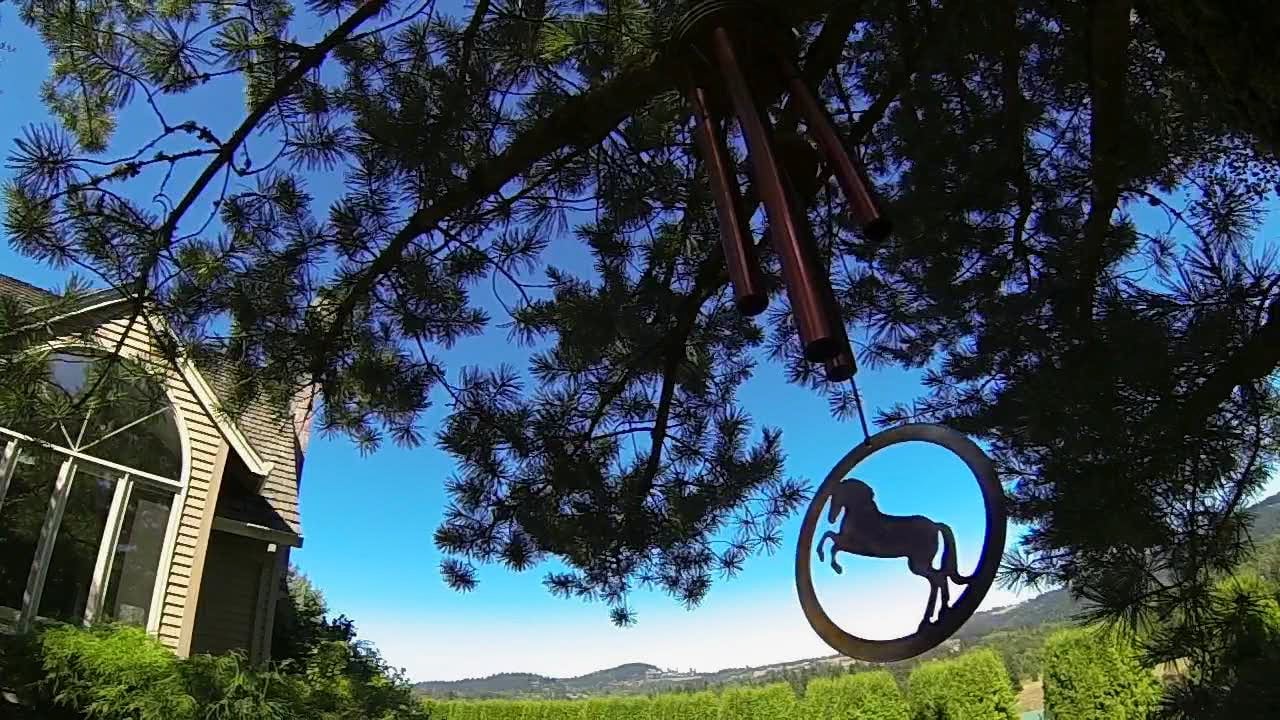
Back in 2012, I came back to Oregon from Japan (where I lived and worked at the time) for a two week vacation with my family, staying at my parent’s house in West Linn. When I wasn’t being asked about my planned comings and goings and my schedule until midnight, one thing I wanted to try out was this new slow motion feature on my trusty iPhone 5. That phone sounds ancient now, but it did the job beautifully. What I made was a cherished memory I often go back to again and again to remind me of all the good times in that brief summer window; like seeing my parents do things they loved, feeding the horse, taking the dog for a walk, and getting the morning paper. Things that without this visual reference, I’m not able to see in my head anymore. But they’re saved forever, to remind me of how things used to be.
My mom had a wind chime with a circular brass horse pattern that clanged the long metal tubes as they swayed in the breeze. In slow motion, those tubes sound like the meditative bells of a Buddhist monastery, peaceful and contemplative. It sets the scene in the video for a somber and sentimental look back at that time.
It captured a slice of life that only existed for a brief period, as all periods are. An open window to my parents in their seventies. They could still walk unassisted, do household things, enjoy the remainder of their days of vitality.
Chapters end and new ones begin. After that video, the retired race horse was gone, followed by the family dog, then mom parted this world as well. It makes me so glad I got those shots when I did. Every time I got a shot, I didn’t have to prepare anyone, light anything, mic anyone up, have them do something over again, none of that. Everything was natural and unrehearsed, so it captured everyone being their true selves, doing things we know and love them for.
All the slow motion shots were a consistent 60 frames a second. The great thing about shooting handheld in slo-mo is that all those extra frames smooth out the footage, making jerky footage less so and making stable moving shots look like you’re floating on a cloud. It makes Steadicam operators out of all of us. In other words, that smoother footage is very forgiving in the hands of amatuer shooters who may not shoot with intention. That would be another suggestion: Even though each shot is brief, know your intention. The camera is going to move from where to where, up or down, forward or back, how far and how fast? Shoot it a couple times until you get the shot you want without any technical mistakes. You’ll know when you get it right.
For your shooting, every shot should be moving in 3D space somehow, craning up or down, pushing in or pulling back, or the subject in the shot should be moving. Running, jumping, leaves falling from trees, snow, whatever. There’s no point of shooting slo-mo where the camera or something in the frame isn’t moving. You don’t need extra frames to capture nothing changing.
Get footage of your family members doing mundane things, and just a few seconds at a time, nothing uncomfortable. Maybe your mom doing laundry, someone vacuuming the carpet, pouring cat litter in the catbox, dad mowing the lawn. Years from now, you’ll look at that footage and think: ‘I remember that cat. He was a nice kitty. That lawn mower was so hard to start and so loud’, things like that.
When you put that footage in a 30 frames per second timeline, that three second shot will double in size to six seconds of smooth footage to choose from. Choose the best two or three seconds of it and move on to your next shot. You put twenty of those quality shots together in the right order and you’ve got a winner.
There are all kinds of free or low cost software out there to edit with that are very user friendly and intuitive, so easy to use, you just learn as you go by playing around with them. My go-to software of choice for editing phone videos is CapCut. Your footage looks spectacular and it’s software tailor made for the cell phone footage world. Find yourself a single music track for the whole thing or find a few for different moods and segments of the video. You can use any music in the universe you like because it’s just for you and your family. It’s not for making money or an attempt to get followers online.
Even though you would be shooting with a smartphone, I would suggest shooting horizontally. It just looks more cinematic and commands your viewing respect compared to shooting vertically like in social media videos.
Click here to see the video in full:
https://vimeo.com/manage/videos/107111984
It’s one of the most cherished videos I have of my family and just gets more valuable with time. Didn’t cost me a penny to make it, didn’t make anyone uncomfortable in the process, and will age like a fine wine in a cellar of memories.
Some of the best things in life are free. This is one of them.
Again, in short:
Shoot in slo-mo, 60fps to 120fps.
Move the camera during the shot and/or have movement in the frame.
Shoot horizontally instead of vertically with your phone.
Every family has stories worth preserving. If you would like to create a professionally-produced legacy for yourself or someone you love, Legacy Ever After can help capture those memories in a timeless way. Contact us to learn more about what your film could be like.
Comments are closed